


How do you write a talk from the Bible?
If you are a leader in a small group, youth group or other such church ministry, you may be keenly aware of the need to preach and teach the Bible, but might not feel you have the time and/or the skills available to undertake this noble task.
This is where the ministry of Video Bible Talks often comes into play. However, while video-based Bible preaching and teaching do have their place (especially in today’s digitally native world), we have never considered our ministry a straight replacement for in-person Bible proclamation.
So, in this post, I’m going to share three simple steps to help you get started with giving a talk from the Bible. This isn’t intended to be a definitive guide, but rather some pointers to get you going.
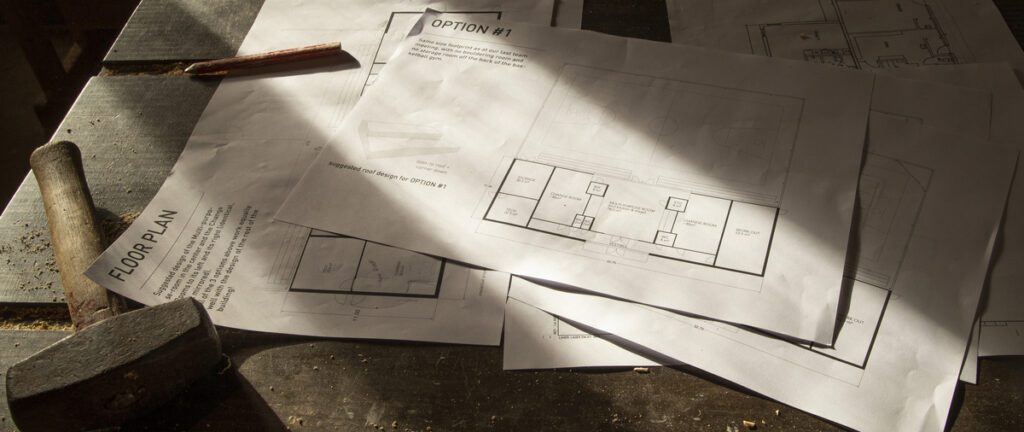
Writing a Bible talk is a lot like constructing a building. In fact, Paul uses the metaphor of building with certain materials to show the Corinthian church the importance of going about ministry in the right way, for the right reasons, using the right tools that God himself has given us (1 Corinthians 3:9–15; Ephesians 2:19–22).
Step #1: Prepare the ground
I’ve broken each step down into three parts. This step includes Prayer, Passage, and Pause.
Prayer
Our words have no power, and our talk will produce no effect unless the LORD is at work in us and through us (Psalm 127:1). So, we pray.
We give thanks to our Heavenly Father for his word, we praise the Son for his salvation, and we ask the Holy Spirit to be at work in us and in the people we serve.
You can obviously pray for much more than this. However, thanking the Father for revealing himself in his word, thanking Jesus for his glorious Gospel, and asking the Spirit to bring about Gospel change in our hearers and us should lie at the heart of our prayers.
Passage
We mustn’t jump straight into writing a talk without taking time to listen to God’s Word personally (James 1:22–25). We need to read and listen to the passage for ourselves.
How much time you spend reading and digesting the passage is up to you. You might want to listen to an audio Bible as you read. You might want to print it out on a separate piece of paper so that you can circle words, highlight phrases or make notes as you go. You might want to look over the passage from different versions (eg, the ESV for literal accuracy, the NLT for ease of reading, and the NIV for a middle ground between these two extremes).
Whatever you do, take time to read, digest and comprehend what God’s word is actually saying in the passage.
Ponder
Once we have read the passage, we must make the effort to understand what is said and, more importantly, what is meant in the text (2 Timothy 2:15). So, we ponder and reflect on God’s word.
Again, how you go about this step is up to you. It would be right to at least take a few moments to think and pray through what you have read, asking God to help you be faithful to his word. In addition to this, you might want to let the passage sink in and meditate on it for a while. You could chat it through with a friend or family member. Many people turn to commentaries and study guides at this point to compare what they are thinking with the thoughts of others on the same passage.
Pondering on God’s word is an important step because the LORD often works in our hearts through the understanding of our minds.
Step #2: Lay the foundation
After preparation, you can start laying the foundations for your talk. As with the preparation step, this step also has three parts to it: Context, Christ, and Construction.
Context
Every verse, passage and book of the Bible has a context. That context matters because it shapes what was written, why it was written, and how it was meant to be received. If we are to be faithful to God’s word, we must teach each passage in a way that fits its context (again, 2 Timothy 2:15).
Take the Ten Commandments in Exodus 20. They are clearly a list of rules to follow. But if we teach them only as rules, we ignore the context and fail to preach this passage faithfully.
The Ten Commandments are set in the context of grace, salvation and worship. In Exodus, God’s people were in slavery, yet the LORD had not forgotten them. By the time we reach Exodus 20, he has already saved them and brought them out. This is seen in what I call Commandment Zero: ‘I am the LORD your God, who brought you out of Egypt, out of the land of slavery’ (Exodus 20:2).
That context is different from ours in some ways, yet also deeply similar. Humanity has forgotten the LORD, yet God has not forgotten us. He has made a way to rescue us from spiritual slavery. And because of his salvation, we now get to live as his rescued people.
Without context, the Ten Commandments can seem like rules to keep God happy. With context, they become a wonderful display of God’s grace and mercy, showing his saved people how to live.
Christ
The whole Bible is about Jesus, his salvation by grace, and his good news proclaimed to the world (Luke 24:45-47). Therefore, Jesus must be at the centre of every Bible talk.
This is easier in some passages than others. It is simple to make Jesus the focus of a talk from one of the Gospels, whereas preaching Jesus from the Song of Songs takes more effort.
But if we remember that the whole Bible is about Jesus and his good news of forgiveness and eternal life, then the main question is simply this: how does this passage point us to him?
Here, it is helpful to remember the ‘shape’ of the Bible is like an hourglass shape. The Old Testament flows towards Jesus, the New Testament flows out from him, and the pinch-point is his life, death, and resurrection. The Gospels bring us to the centre of all history, Jesus Christ, the Son of God.
Back to the Ten Commandments. How do these point us to Jesus? We read them from the post-Jesus side of the hourglass. His life, death, and resurrection shape how we understand them. No one keeps God’s commandments perfectly except Jesus, and he died to give us his righteousness by faith. So we do not keep the Ten Commandments in order to be loved and saved. We are loved by God, saved by Jesus, and therefore, by faith in him, we seek to live as his people should.
Construction
The final part of laying the foundations is to begin to construct a framework for your talk (Titus 1:9).
At the most basic level, each talk has a threefold structure to it: a beginning, a middle and an end. This may seem obvious, but if you are not intentional about thinking through how these three sections work together, your talk might leave people confused as to what you are saying or where you are going.
The beginning serves to take people from where they are to where the passage is.
The middle is there to preach and teach the content of the passage and will make up the bulk of the talk. You might also want to break the middle section down into further subsections to reflect the different points covered in the passage.
The ending is where you make sure that people apply the passage to their lives by faith in Jesus Christ and his wonderful gospel.
Step #3: Build the talk
The final three parts in the process of preparing a Bible talk are as follows: Draft, Delete, Deepen
Draft
Write out a first draft of your talk, from start to finish (Ecclesiastes 12:9–10).
Some people write bullet point notes, others write full scripts. Both of these approaches have their merits and drawbacks. However, from my own experience, I would say that never writing out a talk in full and only writing notes increases the risk of saying things that are irrelevant, unhelpful or even wrong.
Delete
Next, go through the talk and cut out anything unnecessary, unhelpful, or unfaithful (2 Corinthians 4:2). Some things you will want to remove completely, others might just need editing and tweaking to make them better.
In particular, be aware of things in your talk that you think are great but, in reality, are not that great at all. These are often the hardest parts to cut from your talk!
Lastly, make sure that your talk fits the time available. I use a rough guide of 125-150 words per minute. So, if I have twenty minutes for a talk and my draft script is over 3,000 words, then I need to cut things down or cut things out.
Deepen
Deepen your talk so that it leaves your hearers in no doubt of God’s amazing grace and goodness to us in Christ (Luke 24:32).
Sadly, I have sat through far too many ‘space-food’ talks. These are talks that are faithful to the Bible and contain good and helpful points, but are dull and uninspiring. Like space food that has all the nutrition you need in an IV drip, these talks technically feed me from God’s word, but with bland teaching that bypasses my affections.
God’s word is repeatedly described in so many appealing, desirable and tasty ways. Therefore, any preaching and teaching from God’s word must mirror the depth of imagery, tone and emotion that God has given us.
If a passage is exciting, vivid and colourful, deepen your use of language (including body language, where appropriate) to reflect this. Similarly, if a passage is slow, reflective and sombre, make sure your talk has this same depth and sobriety.

The finished work
I trust that the points covered in these three steps have begun to help you see how you can go about preparing a Bible talk to give to your group, in your particular ministry, and make it both full of good truth and appealing to needy souls.
But, in all of this, remember it is God’s word that should be our foundation for whatever ministry we have (Matthew 7:24–27), it is God’s word that is living (Hebrews 4:12), active and able to cut to the heart, and it is God’s word that will ultimately bring people from death to new and everlasting life (1 Peter 1:23–25).
So, as helpful as this post may (or may not) be… make sure your confidence, hope and trust are in Jesus and his good word.


